
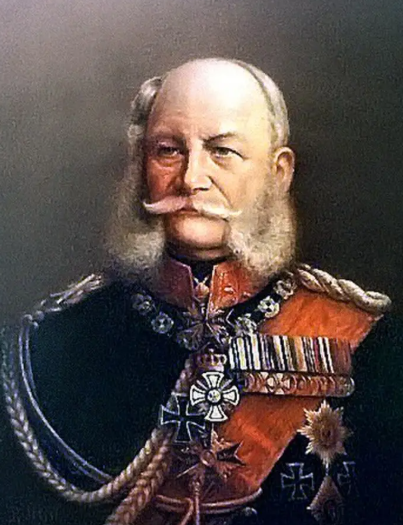
When it comes to German unification, most people immediately think of the Iron Chancellor, Otto von Bismarck. But without the support and foresight of Wilhelm I, none of it would have been possible. Wilhelm I, King of Prussia and the first Emperor of the German Empire, was a key figure in the strategic layout of his era. His political wisdom, military insight, and dedication to national unification made him the true mastermind behind the scenes. Today, let’s take a historical look at how Wilhelm I pushed Germany toward unity through careful strategy and decisive action.
Background: From Prussian Prince to Emperor
Wilhelm I was born in 1797 as a member of the Prussian royal family. He grew up witnessing the aftermath of the Napoleonic Wars, which gave him a deep understanding of the importance of military strength and political stability. By the 1830s, he began to stand out within the royal court and the military, known for his steady and resolute character. When he ascended to the throne in 1840, Wilhelm I focused not only on domestic stability but also on ensuring Prussia would take a leading role among the German states.
Supporting Bismarck: The Beginning of a Strategic Alliance
One of Wilhelm I’s most pivotal decisions came in 1862, when he appointed Otto von Bismarck as Prime Minister. This wasn’t just a political appointment—it was part of a broader strategic plan. Wilhelm understood that royal authority alone could not achieve unification; he needed a politician and strategist who could balance diplomacy, military affairs, and domestic politics. The synergy between Bismarck and Wilhelm allowed Prussia to navigate over a decade of wars and political maneuvers with remarkable steadiness.
Military Reforms: Building the Iron-Blooded Army
A strong military was essential for unifying Germany. Wilhelm I actively promoted the modernization of the army, emphasizing training, discipline, and advanced weaponry. He supported flexible tactical deployments that allowed soldiers to respond swiftly to changing battlefield conditions. These reforms not only strengthened Prussia’s war capability but also laid the foundation for three critical conflicts: the Danish War, the Austro-Prussian War, and the Franco-Prussian War.
Precision Warfare: From Denmark to Austria
In the 1864 Danish War, Prussia and Austria joined forces to seize the duchies of Schleswig and Holstein. Wilhelm I maintained a calm and strategic approach, ensuring Prussia held the upper hand. Two years later, during the 1866 Austro-Prussian War, he skillfully coordinated troop movements, allowing Prussia to quickly defeat Austria and remove a major obstacle on the path to unification. Wilhelm understood that force alone wasn’t enough; political alliances and diplomacy were equally crucial.
The Franco-Prussian War: The Final Step Toward German Unity
The Franco-Prussian War broke out in 1870. Once again, Wilhelm I demonstrated remarkable strategic vision. He supported Bismarck’s diplomatic maneuvers to isolate France while mobilizing Prussian and North German Confederation troops to achieve victory. After the war, on January 18, 1871, Wilhelm I was crowned Emperor of the German Empire at Versailles, marking the true unification of the German states.
The Wisdom of Strategic Planning
Wilhelm I’s strategy extended beyond the battlefield to national governance and diplomacy. He knew how to leverage alliances, reform the military, support political talent, and maintain domestic stability. Wilhelm rarely sought personal glory; he prioritized the nation’s overall interest and the goal of unification. Every decision he made considered both short-term tactics and long-term strategy, ensuring Germany’s firm position by the end of the 19th century.
Conclusion
Looking back at Wilhelm I’s life, we see more than a Prussian king—we see a master strategist behind the scenes. From supporting Bismarck to driving military reforms and taking decisive action in key wars, Wilhelm I provided indispensable leadership for German unification. Without his foresight and steady approach, the birth of the German Empire might have been delayed—or even altered.
Wilhelm I reminds us that history’s pivotal moments don’t only belong to ambitious politicians—they also belong to those who quietly shape change with wisdom and strategy. The story of German unification is a legend written by him and his era, a classic example of strategic genius.
