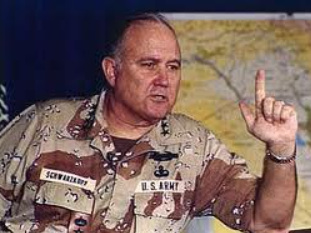
In 1991, a war broke out in the Middle East with little suspense — Iraq’s powerful army was quickly crushed within just 42 days. This conflict, known as the Gulf War, was led by the tall, straightforward, and somewhat humorous four-star General Norman Schwarzkopf, who commanded the U.S. and coalition forces to victory. Calling him the “brain” behind the war is no exaggeration. Today, let’s explore how this legendary American general managed to make his opponent surrender in just 42 days.
Not a Warmonger, but a Natural Tactician
Schwarzkopf was a typical “third-generation military man,” with his father also being a general. He served in the Vietnam War, experienced life-and-death struggles and failures, yet he was not fond of war. In public speeches, he often said, “War is not the best solution, but if it must be fought, I will give it my all to win cleanly and decisively.” His philosophy was clear: war is not about who lasts longer, but who strikes more precisely, fiercely, and swiftly.
Key to Victory: Exceptional Coalition Coordination
Although the U.S. took the lead in the Gulf War, Schwarzkopf commanded a multinational coalition composed of over 30 countries, including the U.S., Britain, France, Saudi Arabia, and Egypt.
This meant he not only had to deploy troops but also manage politics, interpersonal relations, coordination, and communication. Different nations had varied military systems, customs, and even languages. Yet he managed to unite them into a cohesive force — an impressive achievement in itself.
His secret was simple yet practical: respect allies, emphasize communication, and maintain transparency. Unlike other generals who kept themselves above others, he was willing to listen and consider suggestions, even from officers of smaller countries, as long as they made sense.
“Desert Storm”: The Most Powerful Firepower and the “Feint to the East, Strike to the West”
In January 1991, Operation Desert Storm began. Schwarzkopf launched a fierce air campaign lasting 38 days, disrupting Iraq’s air defense and command networks.
What earned the most admiration was his “left hook” ground tactic. Iraq’s main forces were stationed near the Kuwait southern border, ready for a frontal clash with U.S. troops. Instead, Schwarzkopf executed a feint: pretending to attack head-on while maneuvering his main forces around the desert to envelop Iraq’s rear from the west!
This move caught Iraq off guard, throwing front-line troops and command centers into chaos. Elite Iraqi units were either cut off or surrendered, with almost no effective resistance. Schwarzkopf often said: “The best war is one that achieves the greatest effect in the shortest time and with the least cost.” His 42-day victory is the best proof of that.
Not Luck, But Attention to Detail and Preparation
Don’t think this victory was just about superior equipment. While the U.S. had a technological edge, Schwarzkopf’s preparations were meticulous:
- Repeated war games and simulations before battle, constantly refining battle plans;
- Setting clear, executable objectives and contingency plans for every unit;
- Even simulating how tanks would maneuver in desert terrain;
Conducting psychological and media campaigns, proactively releasing information to shape the image of a “just liberation,” winning international support.
Everything was carefully planned, precisely executed, and results controlled — not a “let’s fight and see” approach.
The Real Schwarzkopf: A Tough Leader with Heart
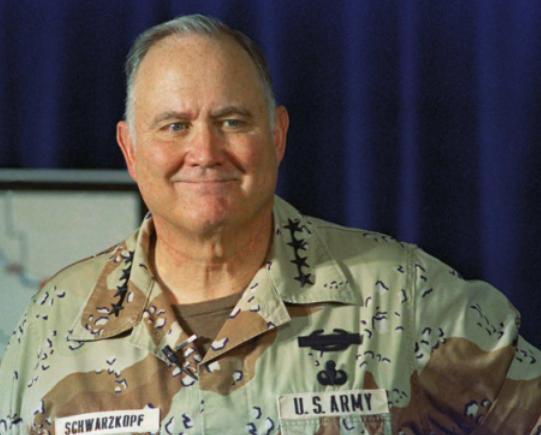
Though always sharp in uniform and concise in speeches, Schwarzkopf was a man of deep emotions behind the scenes. He choked up multiple times when visiting wounded soldiers. He cared deeply for his troops and respected his peers, famously saying, “I will never let my soldiers die in vain,” making him one of the most beloved generals in the military.
Some call him “the last warm-hearted tough guy in the U.S. military,” and that praise is far from exaggerated.
Summary: The Secret to Victory Is Not Just Firepower, But Wisdom
Schwarzkopf’s 42-day war victory was not only due to America’s powerful military but also his calm, meticulous command, flexible strategic vision, and deep understanding of human nature. War is not a video game — it involves tens of thousands of lives.
He used his approach to minimize casualties, maximize efficiency, and made himself an unforgettable figure in U.S. military history.
