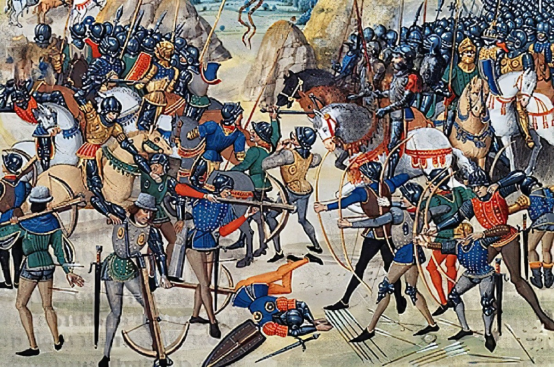
The Hundred Years’ War represents one of the most significant and protracted conflicts of the medieval period, a series of dynastic struggles, territorial disputes, and intermittent battles between the Kingdom of England and the Kingdom of France that spanned from 1337 to 1453. Far from a single, continuous war, it was a complex epoch of warfare punctuated by truces and peace treaties. At its core, the conflict was a fight for control over the French throne and valuable territories. This period of intense rivalry not only reshaped the political map of Western Europe but also catalyzed profound changes in military technology, societal structure, and the very concept of national identity for both England and France. Within this century of conflict, specific events like the Battle of Agincourt stand out as legendary turning points, showcasing dramatic shifts in military strategy and national fortune.
This guide will provide a comprehensive examination of the Hundred Years’ War, dissecting its complex origins, tracing its major phases, and offering a detailed analysis of pivotal moments. We will delve deep into the strategic brilliance and brutal reality of the Battle of Agincourt, exploring how a seemingly doomed English army achieved one of history’s most famous victories. Furthermore, we will analyze the war’s conclusion, the factors that led to the final French victory, and the enduring legacy that continues to influence the relationship between these two nations.
The Tangled Roots: Causes of the Hundred Years’ War
The outbreak of the Hundred Years’ War was not the result of a single grievance but rather the culmination of centuries of intertwined history and escalating tensions between the English and French monarchies. Three primary factors converged to ignite this prolonged conflict: a dynastic crisis in France, long-standing territorial disputes, and deep-seated economic rivalries.
The Dynastic Crisis and English Claim to the French Throne
The most direct cause was the succession crisis following the death of the French King Charles IV in 1328 without a male heir. This ended the direct line of the Capetian dynasty. The main claimants to the throne were Philip of Valois, a French nobleman and Charles’s cousin, and Edward III of England. Edward’s claim was through his mother, Isabella, who was Charles IV’s sister. The French nobility, however, invoked Salic Law, an ancient legal code they interpreted as barring succession through a female line. Consequently, they crowned Philip as King Philip VI. Edward III initially accepted this outcome, but this unresolved claim provided him with a powerful justification for war when political and territorial tensions boiled over a decade later.
Territorial Disputes Over Gascony
A long-standing point of friction was the status of the Duchy of Gascony (or Aquitaine) in southwestern France. This territory was a remnant of the vast Angevin Empire and was held by the English king, but as a vassal to the French crown. This created an inherently unstable feudal relationship: the King of England, a sovereign in his own right, was required to pay homage to the King of France for his French lands. French kings repeatedly used this feudal power to interfere in Gascon affairs, while English kings resented the subordination. In 1337, Philip VI confiscated Gascony, an act that directly triggered Edward III’s military response and his formal assertion of his claim to the French throne.
Economic Rivalry and National Alliances
Economic interests, particularly concerning the prosperous County of Flanders (modern-day Belgium), played a crucial role. Flanders was technically a fief of the French crown, but its cloth-making industry was entirely dependent on raw wool imported from England. This created a split loyalty. The Flemish urban elites favored England to protect their economic lifeline, while the French-aligned Count of Flanders supported Philip VI. This economic battleground provided a proxy for the larger Anglo-French conflict and fueled the formation of strategic alliances that would define the war’s early stages.

The Battle of Agincourt: England’s Legendary Victory
Fought on October 25, 1415, the Battle of Agincourt is one of the most celebrated and studied military engagements in history. It stands as a testament to the tactical genius of King Henry V and the devastating effectiveness of the English longbow, resulting in a catastrophic defeat for a much larger French army. The battle occurred during the Lancastrian phase of the war, after Henry V renewed the English claim to the French throne and launched an invasion of France.
Prelude to Conflict: Henry V’s 1415 Campaign
Henry V’s campaign began with the successful but costly siege of Harfleur. The siege took longer than expected, and the English army was ravaged by dysentery. With his forces significantly weakened and winter approaching, Henry decided to march his army overland from Harfleur to the English-held port of Calais—a provocative march through French territory. A large French army, led by the Constable of France, Charles d’Albret, shadowed and eventually blocked the English path near the village of Agincourt, forcing a confrontation that the exhausted English had sought to avoid.
The Opposing Forces: A Study in Contrasts
The two armies that met at Agincourt were drastically different in size, composition, and condition. The disparity in numbers was stark, though exact figures are debated by historians. The English were heavily outnumbered, with estimates suggesting Henry V commanded around 6,000 to 8,000 men, the vast majority of whom were longbowmen. The French force was significantly larger, possibly numbering between 20,000 and 30,000, and was dominated by heavily armored men-at-arms and knights, both mounted and on foot.
| Feature | English Army | French Army |
|---|---|---|
| Estimated Size | 6,000 – 8,000 | 20,000 – 30,000 |
| Composition | ~80% Longbowmen, ~20% Men-at-Arms | Dominated by heavily armored knights and men-at-arms |
| Leadership | King Henry V (present on the field) | Constable Charles d’Albret (King Charles VI was mentally unfit) |
| Condition | Exhausted, hungry, and suffering from dysentery | Well-supplied, confident, but over-confident and poorly disciplined |
The Decisive Role of the English Longbow
The key to the English victory was the longbow. This weapon was not merely a bow; it was a sophisticated military system. Made from yew, it was six feet long and had a draw weight of over 100 pounds, capable of firing armor-piercing bodkin-point arrows over 250 yards. A trained English archer could fire 10-12 arrows per minute, meaning Henry’s 5,000 archers could unleash a “storm of arrows” at a rate of nearly 1,000 per second. The archers protected their positions by planting sharpened wooden stakes in the ground before them, creating a deadly defensive barrier against cavalry charges.
The Battle Unfolds: A Step-by-Step Account
The battlefield itself, a narrow strip of muddy ploughland between two woods, played directly into Henry’s hands. It prevented the larger French army from outflanking him and forced them into a narrow, congested frontal assault.
- The English Advance: After a tense standoff, Henry V took a calculated risk and advanced his army into longbow range, provoking the French to attack.
- The French Charge: The French knights, impatient for glory, launched a disorganized charge across the field. The recent heavy rain had turned the ground into a deep, clinging mud, which exhausted the heavily armored men-at-arms before they even reached the English lines.
- The Arrow Storm: As the French advanced, they were met with a relentless barrage of arrows from the English longbowmen positioned on the flanks. The arrows inflicted horrific casualties, wounded horses, and caused chaos in the French ranks.
- The Melee: The French who survived the arrow storm reached the English line in a disorganized, exhausted mass. They were so tightly packed in the mud that they could barely lift their weapons. The lightly armored English archers dropped their bows, picked up swords and axes, and joined their men-at-arms in the brutal melee, slaughtering the trapped and immobile French knights. The victory was total and overwhelming.

Analyzing the Aftermath: Agincourt’s Impact on the War
The victory at Agincourt had immediate and profound consequences for both England and France. While it did not win the war for England outright, it served as a massive propaganda victory and severely crippled the French leadership for years to come. It was a turning point that shifted the momentum of the Lancastrian War decisively in England’s favor.
Immediate Consequences for France and England
For England, the victory was a divine validation of Henry V’s claim to the French throne. It solidified his position as a formidable warrior-king, allowing him to secure massive funding from the English Parliament for future campaigns. For France, the defeat was a national catastrophe. An entire generation of its military and political leadership was wiped out on the battlefield. The casualties included the Constable of France, three dukes, five counts, and hundreds of other prominent nobles who were either killed or taken for ransom. This power vacuum exacerbated the ongoing French civil war between the Armagnacs and Burgundians, paralyzing the French response to subsequent English invasions.
The Treaty of Troyes (1420)
Capitalizing on the French political chaos, Henry V continued his conquest of Normandy. The weakness of the French crown, coupled with the alliance between England and the powerful Duke of Burgundy, led to the Treaty of Troyes in 1420. This treaty was a direct result of the leverage gained at Agincourt. Under its terms:
- Henry V was recognized as the heir to the French throne.
- He married Catherine of Valois, the daughter of the French King Charles VI.
- The Dauphin, Charles (the future Charles VII), was disinherited.
This treaty effectively created a dual monarchy, uniting the crowns of England and France. Had Henry V not died unexpectedly in 1422, the history of Europe might have been vastly different.

The Turning Tide and the End of the War
Despite the English position being stronger than ever following the Treaty of Troyes, the tide of the war began to turn against them. The death of Henry V and the resilience of French nationalism, embodied by a young peasant girl, sparked a remarkable revival that ultimately led to the expulsion of the English from French soil.
The Rise of Joan of Arc
The turning point for the French came in the form of Joan of Arc. In 1429, she convinced the disinherited and demoralized Dauphin Charles that she was sent by God to save France. Her presence had an electrifying effect on French morale. She famously led the French army to lift the English siege of Orléans, a victory of immense strategic and psychological importance. This victory turned the tide of the war, inspiring a renewed sense of belief and purpose among the French. Shortly after, she escorted Charles to Reims, the traditional site of French coronations, where he was officially crowned King Charles VII, legitimizing his claim to the throne in the eyes of his people.
French Military Reforms and the Power of Artillery
While Joan of Arc provided the spiritual inspiration, Charles VII’s government implemented crucial military and financial reforms that created a permanent, professional standing army—the first in Europe since Roman times. A key element of this modernization was the development of superior artillery. Under the guidance of the Bureau brothers, French cannon technology became the most advanced in the world. This artillery was instrumental in systematically reducing English-held castles and fortified towns, making the traditional English strategy of holding territory untenable. The final major battle of the war, the Battle of Castillon in 1453, was a decisive French victory won almost entirely by artillery, signaling the end of the era of the longbow’s dominance.

The Enduring Legacy of the Hundred Years’ War
The conclusion of the Hundred Years’ War in 1453, with the English retaining only the port of Calais, marked a pivotal moment in European history. The conflict’s legacy extended far beyond territorial changes, fundamentally reshaping the political, social, and military landscapes of both England and France.
Forging National Identities
Perhaps the most profound legacy of the war was the development of distinct national identities. Before the conflict, the nobility of both nations shared a common French language and aristocratic culture. The long years of warfare fostered a sense of “Englishness” and “Frenchness” that had not previously existed. The shared struggle against a foreign enemy united the people of France behind their king, while in England, the loss of continental territories forced the monarchy and nobility to focus on England as their primary domain, solidifying English as the language of government and culture.
Military Innovation and the Decline of Feudalism
The war was a crucible of military innovation. It began with the dominance of the feudal knight but ended with the supremacy of infantry and artillery. The English longbow demonstrated that peasant archers could defeat heavily armored aristocrats, while French cannons proved that stone castles were no longer impregnable. These developments undermined the military basis of feudalism. Kings no longer had to rely solely on their vassals for military service; they could raise and pay for professional armies equipped with the latest technology, centralizing power and laying the groundwork for the modern nation-state.

Major Phases of the Century-Long Conflict
The Hundred Years’ War is typically divided by historians into three main periods of fighting, separated by years of truce or lower-intensity conflict. Understanding these phases helps to contextualize key battles and strategic shifts over the 116-year period.
The Edwardian War (1337–1360)
This initial phase was named for England’s King Edward III. It was characterized by stunning English victories, largely due to the tactical superiority of the longbow. Key battles like the naval victory at Sluys (1340), the decisive land victory at Crécy (1346), and the capture of the French King John II at the Battle of Poitiers (1356) demonstrated the effectiveness of English strategy. This phase concluded with the Treaty of Brétigny (1360), which granted Edward III full sovereignty over extensive territories in France in exchange for him renouncing his claim to the French throne.
The Caroline War (1369–1389)
Named after King Charles V of France, this phase saw a dramatic French resurgence. Charles V, known as “the Wise,” avoided large-scale pitched battles with the English. Instead, he employed a Fabian strategy of attrition, using guerrilla tactics, skirmishes, and sieges to slowly reconquer territory. Led by the brilliant constable Bertrand du Guesclin, the French systematically pushed the English back, reclaiming almost all the lands lost in the previous phase. By the end of this period, England held only a few coastal enclaves, including Calais.
The Lancastrian War (1415–1453)
The final and most famous phase of the war began when King Henry V of England renewed the English claim and invaded France. This period saw the legendary English victory at Agincourt (1415) and the subsequent conquest of Normandy, culminating in the Treaty of Troyes (1420). However, the English fortunes were reversed following the appearance of Joan of Arc and the French victory at the Siege of Orléans (1429). Empowered by military reforms and superior artillery, the French gradually drove the English out, culminating in the final victory at the Battle of Castillon in 1453.
Frequently Asked Questions (FAQ)
- Q1: Was the Hundred Years’ War actually 100 years long?
- No, the term is a historical label for a series of conflicts that spanned 116 years, from 1337 to 1453. The fighting was not continuous; it was punctuated by several truces and periods of peace. The name “Hundred Years’ War” was coined by historians in the 19th century to describe this extended period of Anglo-French hostility.
- Q2: Why was the English longbow so effective at the Battle of Agincourt?
- The longbow’s effectiveness came from a combination of factors. It had a tremendous rate of fire (10-12 arrows per minute), long range (over 250 yards), and its armor-piercing bodkin arrows could penetrate the plate armor of French knights. At Agincourt, the muddy terrain slowed the French charge to a crawl, making them easy targets for the thousands of English archers who unleashed a devastating “arrow storm” that caused chaos and massive casualties before the main melee even began.
- Q3: What was Joan of Arc’s real role in the war?
- Joan of Arc’s primary role was as a spiritual and inspirational leader. While she did participate in military planning and battles, her greatest impact was on French morale. At a time when French forces were demoralized and defeated, she provided a renewed sense of divine purpose and national pride. Her leadership at the Siege of Orléans led to a pivotal victory that shifted the war’s momentum in favor of the French and paved the way for the coronation of Charles VII, legitimizing his rule.
- Q4: Who ultimately won the Hundred Years’ War?
- France was the ultimate victor of the Hundred Years’ War. Despite suffering catastrophic defeats like Crécy, Poitiers, and Agincourt, the French monarchy eventually succeeded in expelling the English from all their continental territories, with the sole exception of the port of Calais. The war solidified the power of the Valois dynasty and led to a more centralized and powerful French state.
- Q5: How did the war change medieval warfare?
- The war marked a major transition in military technology and tactics. It demonstrated the decline of the heavily armored knight as the dominant force on the battlefield, replaced by disciplined infantry (like English longbowmen) and, eventually, powerful artillery. The French use of cannons to systematically destroy English-held castles in the final phase of the war signaled the end of the castle’s military supremacy and the dawn of a new age of gunpowder warfare.