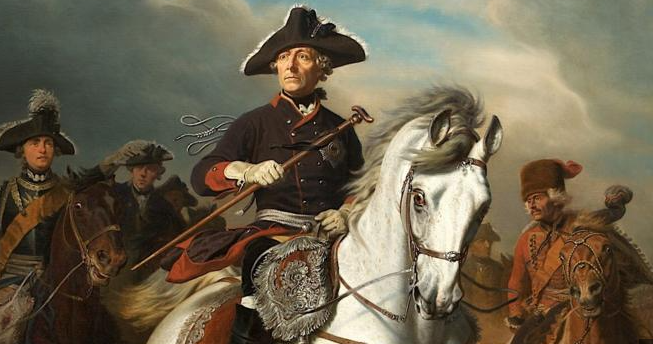
When many people think of Frederick the Great, they immediately think of the “Iron God of War,” the tough monarch who turned the tide of the Seven Years’ War and propelled Prussia onto the European stage. However, if you limit his image to a “cold-blooded military genius,” you overlook his complex, even contradictory side. This seemingly powerful king actually carried the weight of loneliness and conflict deep within. Today, let’s explore the true nature of this “lonely monarch.”
Military Genius: Ruthlessness and Courage
In the history of European warfare, Frederick’s name is synonymous with precision strikes. He excelled at achieving major victories with a small force, employing flexible and maneuverable tactics to repeatedly crush his enemies. During the Seven Years’ War, facing the combined forces of Austria, France, Russia, and other major powers, Prussia was practically surrounded on all sides. Yet, Frederick, with his masterful military command and exceptional mental fortitude, led his troops to victory after victory, achieving classic victories.
That’s why Napoleon said, “Before me, the greatest general was Frederick.” This was not a compliment, but true admiration.
But behind this “God of War” image lay a calm, even cold, understanding of the cruelty of war. He understood that soldiers were merely part of the state machine. He could ruthlessly command his troops to charge forward, and he could also remain unwavering even in the face of heavy losses. His toughness, to some extent, made Prussia successful, but it also often earned him the reputation of being cold-blooded.
Art Lovers: Poets and Musicians
While Frederick was ruthless on the battlefield, at the palace he enjoyed playing the flute, writing poetry, and discussing philosophy. In his youth, he even yearned for literature and music rather than the military and guns. He and Voltaire had a long correspondence, discussing Enlightenment thought, literature, and politics.
Frederick, often called the “Philosopher King,” would pick up his flute and play Baroque melodies in the quiet of the Prussian palace, temporarily detaching himself from the bloody battlefield.
Isn’t that a contradiction? A king who commanded armies and made life-or-death decisions during the day, yet at night he immersed himself in a gentle world of music and words, like a young artist.
Rebellious Teenager: Stepping Out of His Father’s Shadow
Frederick’s contradictory character was foreshadowed in his youth. His father, Frederick William I, was a complete military enthusiast who expected his son to be a “soldier king.” But young Frederick was completely different. He loved art and poetry and even considered escaping royal life.
The conflict between father and son was once so intense that it seemed almost irreconcilable. Frederick’s rebellious youth led to extreme tensions with his father, and he was nearly executed for “defection.” Ultimately, he chose not to flee. Instead, after his father’s death, he forcibly merged his two identities as a soldier and an artist in his own unique way.
It is precisely because of this background that he spent almost his entire life wavering between these two identities: an iron-blooded king and a lonely art lover.
The Loneliness of the Monarch: The Loneliness Behind the Glory
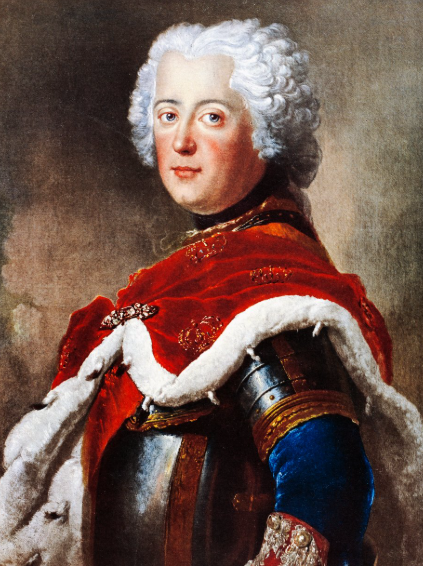
Frederick won glory for Prussia but not personal happiness. Although he was a formidable warrior on the battlefield, he often felt isolated in his personal life. His marriage was devoid of affection, and he had very few people around him who truly understood him. His friendship with Voltaire briefly provided him with spiritual comfort, but the two eventually parted ways due to disagreements.
A king who could control the overall situation politically and militarily, but could not find true emotional support, this loneliness was perhaps the source of his deepest inner contradiction.
Legacy and reflection: Why is he fascinating?
Frederick the Great’s achievements are clear: he forged a once-difficult Prussia into the fold of Europe’s great powers. His military thinking influenced the entire continent, and his style of rule established Prussia as the foundation of the German Empire. But even more fascinating is his profound personality, a man of many contrasts.
He could treat his soldiers ruthlessly, like war machines, yet he could also play his flute tenderly to serenade them; he was both a decisive dictator and a philosopher fond of enlightenment. He used tough measures to establish his country, but used words and music to comfort his lonely heart.
This sense of contradiction is why he has become a “legend.” After all, if he were just a general or an artist, he might not have left such a deep mark in history.
Summarize
“A lonely monarch” is perhaps the most fitting description of Frederick the Great. His loneliness stemmed from the contradictions of his identity: he had to be a ruthless leader while craving the solace of poetry; he had to shoulder the responsibility of his country’s survival while also desiring personal freedom.
It is this contradiction that gives depth to his life story and inspires both admiration and curiosity among future generations. Frederick the Great was not only a controller of the war machine, but also a soul struggling between loneliness and glory.
Perhaps, this is what makes him most touching.
