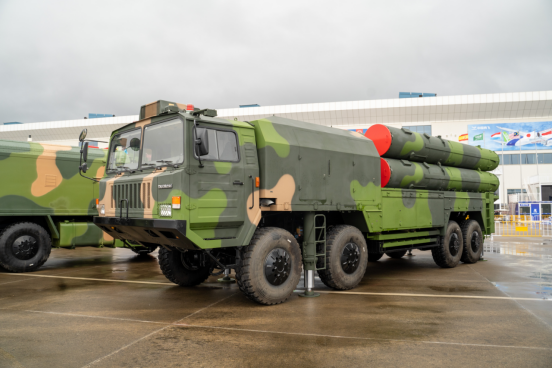
In the complex theater of global military strategy, the development of advanced defensive systems often signals a significant shift in the balance of power. China’s HQ-19 anti-ballistic missile (ABM) system is one such development, a technological leap that positions Beijing as a major player in the exclusive club of nations with credible missile defense capabilities. More than just a piece of hardware, the HQ-19 represents a cornerstone of China’s strategic deterrent and its ambition to secure its interests against high-tech threats. This guide provides an in-depth analysis of the HQ-19, its underlying technology, its comparison with global counterparts, and the profound geopolitical shockwaves it is creating.
What is the HQ-19? A Technical Deep Dive
The Hongqi-19, or HQ-19, is a road-mobile, mid-course anti-ballistic missile system developed by the People’s Republic of China. It is the upper-tier component of China’s layered missile defense network, designed to intercept intermediate-range (IRBMs) and potentially intercontinental-range (ICBMs) ballistic missiles outside the Earth’s atmosphere. Its primary function is to neutralize threats during the “mid-course” phase of their trajectory—the long, predictable arc through space before they re-enter the atmosphere.
The “Hit-to-Kill” Principle: Kinetic Kill Vehicle (KKV)
The core of the HQ-19’s lethality is its Kinetic Kill Vehicle (KKV). Unlike traditional missiles that use explosive warheads to destroy targets through fragmentation, the HQ-19 employs a direct-impact, “hit-to-kill” approach. The KKV is a sophisticated, self-guided projectile that detaches from the main booster rocket in space. Using its own set of sensors and thrusters, it maneuvers at hypersonic speeds to physically collide with the incoming enemy warhead. This method ensures complete destruction of the target through sheer kinetic energy, leaving no chance for the warhead to detonate.
System Components and Operation
A typical HQ-19 battery consists of several key elements working in concert:
-
Transporter Erector Launcher (TEL):
A mobile launch vehicle that provides high mobility, allowing the system to be deployed rapidly and making it harder for an adversary to locate and target. -
Interceptor Missiles:
The two-stage solid-fuel rockets that carry the KKV to its target altitude and velocity. -
Advanced Radar Systems:
Sophisticated early-warning and tracking radars are essential for detecting an incoming missile launch, calculating its trajectory, and guiding the interceptor. These are likely integrated with China’s broader space and ground-based sensor network.

HQ-19 vs. Global Counterparts: A Comparative Analysis
The HQ-19 is often compared to the American THAAD (Terminal High Altitude Area Defense) system, but it also shares characteristics with other elite ABM systems. Understanding these comparisons reveals its strategic positioning in the global missile defense landscape.
| System | Country | Interception Phase | Kill Mechanism | Primary Target |
|---|---|---|---|---|
|
HQ-19 |
China | Mid-course (Exo-atmospheric) | Kinetic Kill Vehicle (KKV) | IRBMs & ICBMs |
|
THAAD |
USA | Terminal (Exo/Endo-atmospheric) | Kinetic Kill Vehicle (KKV) | SRBMs & IRBMs |
|
Aegis SM-3 |
USA / Allies | Mid-course (Exo-atmospheric) | Kinetic Kill Vehicle (KKV) | SRBMs & IRBMs |
|
S-500 ‘Prometey’ |
Russia | Mid-course & Terminal | Kinetic Kill & Blast-Frag | IRBMs, ICBMs, Aircraft |
Deep Dive: HQ-19 vs. US THAAD
While both systems use hit-to-kill technology, their operational philosophy differs. THAAD is designed to intercept missiles in their final, or “terminal,” phase as they descend towards their target, operating at the very edge of and just inside the atmosphere. The HQ-19, like the US Navy’s SM-3, is a dedicated mid-course interceptor, designed to destroy threats high in space. This gives the defender more time and a larger engagement window. The development of the HQ-19 suggests China is not merely copying THAAD but developing a parallel and complementary capability to create a multi-layered shield.

Strategic Implications: Reshaping the Geopolitical Chessboard
The deployment of a credible mid-course ABM system like the HQ-19 has profound consequences for international security and strategic stability. It fundamentally alters the calculations of military planners in Washington, Moscow, and New Delhi.
Challenging US Nuclear Primacy
For decades, the concept of Mutually Assured Destruction (MAD) has been a cornerstone of nuclear stability. The idea is that no country would launch a first strike because they could not survive the inevitable retaliation. A robust missile shield, however, could theoretically absorb a retaliatory strike, making a first strike more conceivable. While the HQ-19 is far from an impenetrable shield, its existence complicates US strategic planning and erodes the perception of America’s unchallenged nuclear dominance.
Bolstering China’s A2/AD Bubble
The HQ-19 is a critical enabler of China’s Anti-Access/Area Denial (A2/AD) strategy in the Indo-Pacific. This strategy aims to prevent US forces from operating freely near China’s coast. By protecting key command centers, military bases, and naval assets from ballistic missile attack, the HQ-19 allows China’s offensive forces to operate with greater security, significantly raising the risks for any potential adversary in a regional conflict, particularly concerning Taiwan.
Fueling a New Arms Race
The success of the HQ-19 will inevitably spur further investment in missile defense and offensive countermeasures by other powers. The United States will likely accelerate the development of hypersonic weapons and more sophisticated reentry vehicles designed to evade such defenses. Regional powers like Japan and South Korea may seek to enhance their own missile shields, while India will watch China’s capabilities with increasing concern, potentially leading to a dangerous and costly arms race across Asia.
Expert Advice: Understanding Ballistic Missile Defense
To fully grasp the significance of the HQ-19, it’s crucial to understand the basic principles of intercepting a ballistic missile. Here is a checklist of key concepts:
-
Boost Phase:
The initial phase where the missile’s rockets are firing. The missile is slow, hot, and highly visible, making it an ideal but extremely difficult time to intercept due to the short window and proximity to enemy territory. -
Mid-course Phase:
The longest phase, where the warhead travels on a predictable arc through the vacuum of space. This is the primary engagement window for systems like the HQ-19 and Aegis SM-3. The challenge here is distinguishing the real warhead from decoys. -
Terminal Phase:
The final phase, where the warhead re-enters the atmosphere and descends towards its target at immense speed. This is the last chance for interception, targeted by systems like THAAD and the Patriot PAC-3. -
Layered Defense:
The most effective missile defense strategy. It involves using different systems to provide multiple interception opportunities across the mid-course and terminal phases, increasing the overall probability of a successful defense. The HQ-19 is a key part of China’s emerging layered defense.
Frequently Asked Questions (FAQ)
-
How does the HQ-19 differ from an air defense system like the S-400?
- The S-400 is primarily an air defense system designed to shoot down aircraft, cruise missiles, and short-range (tactical) ballistic missiles within the atmosphere. The HQ-19 is a dedicated anti-ballistic missile system designed for exo-atmospheric (space-based) interception of long-range strategic missiles, which travel much higher and faster.
-
Is the HQ-19 capable of shooting down satellites (ASAT)?
- Yes, the technology is inherently dual-use. A mid-course interceptor designed to hit a warhead in space can be adapted to target satellites in low Earth orbit. China has already demonstrated this capability with other systems, and it is widely believed that the HQ-19 possesses a significant anti-satellite (ASAT) capability, adding another layer to its strategic importance.
-
How many HQ-19 systems does China have?
- The exact number of operational HQ-19 batteries is a closely guarded state secret. However, based on successful and publicized tests, it is confirmed to be operational. Deployment is likely focused on protecting high-value strategic locations and political centers within mainland China.
-
What is the biggest challenge for a system like the HQ-19?
- The single biggest challenge is dealing with countermeasures. An attacker can use multiple warheads (MIRVs) and a cloud of sophisticated decoys to overwhelm the defense system’s sensors and interceptors. Discriminating between a lightweight decoy and a heavy warhead in the vacuum of space is an immense technical challenge that all ABM systems face.
