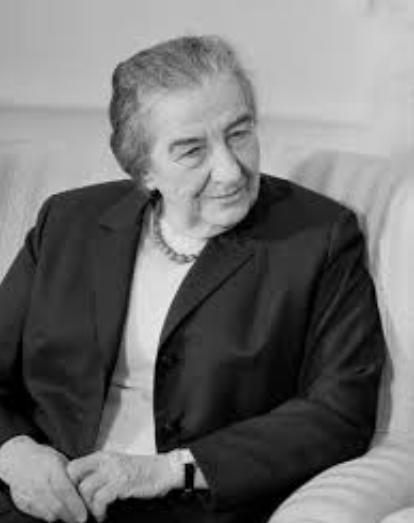
When people hear the nickname “Iron Lady,” they often think of Margaret Thatcher. But long before Thatcher rose to power in Britain, the Middle East already had its own true Iron Lady—Golda Meir, Israel’s first and most iconic female Prime Minister.
She wasn’t a political celebrity drawn to the spotlight, nor a leader who relied on slogans or image. She was a woman who carried the burden of a nation with sheer willpower, action, and a deep sense of duty. In an era of war and crisis, her iron resolve held the fate of her country steady.
From Poor Immigrant Girl to Founding Mother – A Leader Born from Struggle
Meir was born into a poor Jewish family in Russia, and from a young age, she experienced the harshness of anti-Semitism. Her family was so poor they couldn’t even afford shoes, eventually emigrating to the U.S.
She grew up in Milwaukee, juggling school and part-time work, while organizing speeches and joining Zionist movements—never the obedient, quiet type.
In the 1920s, she made the bold decision to immigrate to Palestine (before Israel was founded), working on a dry, hot kibbutz farm, teaching, and living a modest life with her husband. Her ideals weren’t theoretical—they were lived out through action.
A Tough Diplomat Who Could Slam the Table—or Cry
Few people know that Meir rose to prominence through diplomacy. In 1948, before Israel’s declaration of independence, she was secretly sent to the U.S. to raise funds. Driving a beat-up car, she went door to door and managed to raise $50 million in just a few weeks—money that directly funded Israel’s early war for independence.
After the founding of Israel, she became ambassador to the Soviet Union, and later served as Foreign Minister for over a decade.
She could use dry Jewish humor to break tension, and stand her ground fiercely at the United Nations. She didn’t rely on shouting—she commanded respect through calm conviction and a quiet authority that made it clear: I know what needs to be done.
Prime Minister by Necessity – A Reluctant Guardian of the Nation
In 1969, after Prime Minister Levi Eshkol passed away, Israeli politics fell into disarray. The party couldn’t find a clear successor, and the senior leadership essentially persuaded Meir to take the job. She was already 70, in poor health, and had no ambition to become Prime Minister. But someone had to lead, and she stepped up.
From the start, she faced tremendous pressure: terrorism, Arab League hostility, international isolation, and domestic division. But she didn’t panic or put on a show of strength. Her strength was quiet, focused, and grounded in dealing with reality head-on.
She once said, “I don’t know what a female Prime Minister is supposed to be like. I just know Israel cannot be without leadership.” It sounded plain, but it captured the grit and weight she carried.
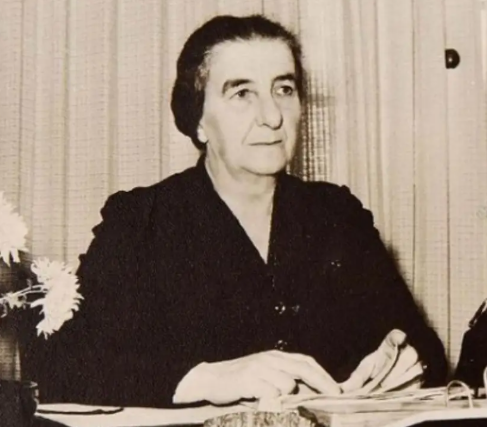
Yom Kippur War: Her Darkest Hour, and Her Most Human
The 1973 Yom Kippur War was the most harrowing moment of Meir’s life. She failed to authorize preemptive mobilization, and Israel was caught off guard, suffering heavy losses. The political and psychological pressure on her was immense.
That night, she didn’t sleep. She personally ordered a full-scale reserve mobilization and reached out to the U.S. for urgent aid. After the war, she publicly accepted responsibility. She wasn’t a superhero—she cried, regretted, and blamed herself.
But she never abandoned her duty. Even knowing she’d face criticism and lose public favor, she put the country first. Many say the war marked the end of her political career, but for many Israelis, it elevated her image as the “mother of the nation.”
Her Strength Wasn’t in Her Voice, But in What She Carried
Meir’s “iron” wasn’t cold or authoritarian—it was the quiet resilience of someone who had endured storms and still stood firm.
She once said, “We want peace, but not at the cost of our right to live.” She understood the pain of war, but also the cost of peace.
She wasn’t a perfect leader, but in times of extreme complexity, she held the line, kept the nation steady, and bore the burden of criticism without backing down. That’s the mark of a true guardian.
In the End, the Iron Lady Was Also a Mother
Meir wore many hats—Prime Minister, wartime leader, diplomatic warrior—but she always saw herself as an ordinary person. She didn’t wear designer suits or put on airs. She cooked, smoked, and handwrote memos—just like many regular mothers.
Yet it was this seemingly ordinary older woman who held Israel together during one of its most turbulent periods. “We have nowhere else to go, so we must be strong.” That sentence sums up her entire life.
